A case built one restroom at a time.
No lab. No grant. No institution. Just the question — and three years of refusing to let it go.
Three years. 226 restrooms across five states. 169 dryers. 462 hand-drying trials. 103 paper towels — 58 white, 45 brown, each counted by hand. 1,076 culture dishes. 50,000 hand-counted bacterial and fungal colonies.
Eleven science-journal preprints. One filed federal civil lawsuit. Fifteen sample complaints for harmed purchasers. Five complaints to the federal agencies. Eight hours of documentary video.
Every claim the industry makes was tested. Every claim failed.
How it started
Ron Blouch, our founder, began noticing mold growing underneath the hand dryers in several Starbucks stores he frequented in 2023. The restrooms were otherwise clean. Why was something growing under the dryers — and why did that seem to be allowed?
In September of 2023, with his then twelve-year-old daughter, he bought a set of petri dishes from Amazon and ran a test: inside-store air, outside-store air, a control, and the dryer output. Here is the result.
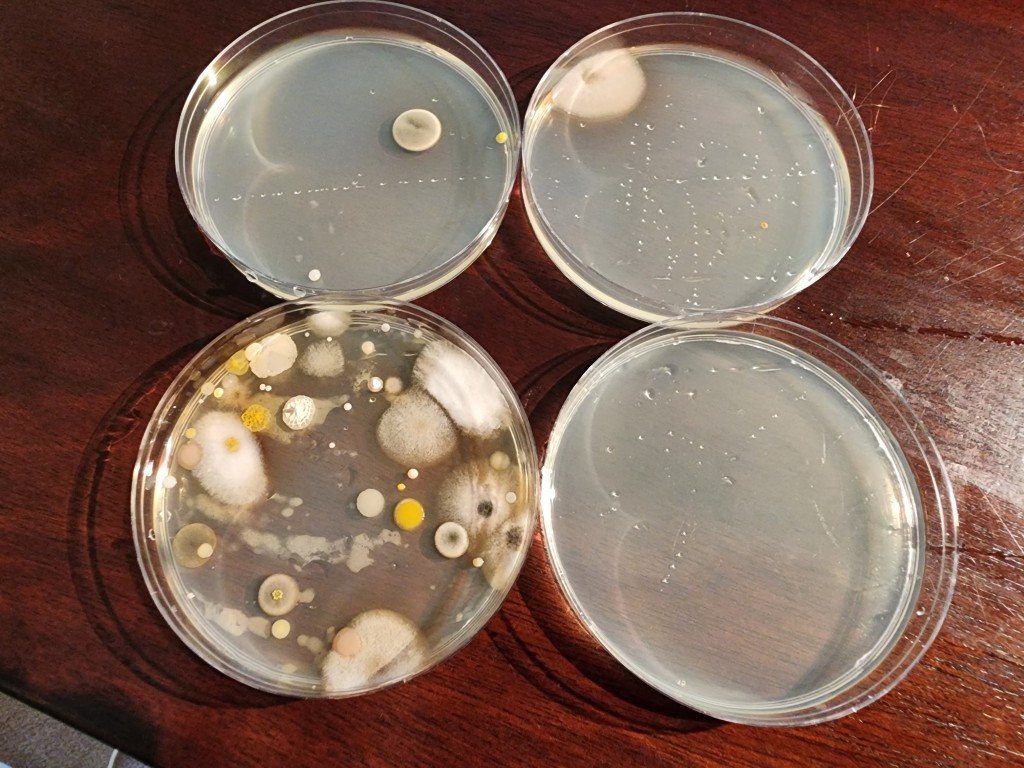
One test was a curiosity. At 30 tests it became a mission. Then a federal lawsuit.
Near the end of the first round of testing in early 2024, as he began to research the dryers, the manufacturers, and their science, he discovered that hand dryer manufacturers claimed their machines dried hands in eight or twelve seconds. He was incredulous. No dryer he’s ever encountered dried in less than 60 seconds. That single finding launched a two-year investigation into the companies, the certifying bodies, the federal agencies that oversee the industry, the prior science on the subject, and finally the legal cases that bring you to this website.
The only reasonable conclusion is that they all know and have known for decades.
Ron’s federal civil suit is built specifically to prove it — aimed with laser precision at the corporate targets and the people involved.
Every door he knocked on closed
Ron spent two years trying to give the problem back to those who created it. In March of 2025 Ron approached Starbucks with the problem, hoping they would act. They refused to speak with him at all — including during a week-long visit to corporate headquarters in Seattle in April of 2025. He got an identical response from Home Depot.
He then took the problem to attorneys, finding a well-known New York City class-action firm that was interested. After two months of work together, he realized they wanted the case without reasonable payment up front or a share in any damages on the back side. He fired them. He used what he had learned after a lifetime of personal and business legal work from the consumer side to build the case and identify the certifying companies you can see named in the complaint published on this site.
Then he approached those companies directly, once more trying to give the problem back to those who created it for resolution. They declined.
Why independence is the point
All of it — the fieldwork, the counting, the reading of every standard and certification document, the writing of the complaint — was done by one investigator, by hand, with no team and no institution behind him. That is not a limitation. It is the asset. There was no client steering the result, no funder to please, no employer whose product was under examination. The work answers to the evidence and nothing else — which is exactly what a user, a court, and a defendant, has to reckon with. The conclusions are uncomfortable because no prior paid party had a reason to reach them.